

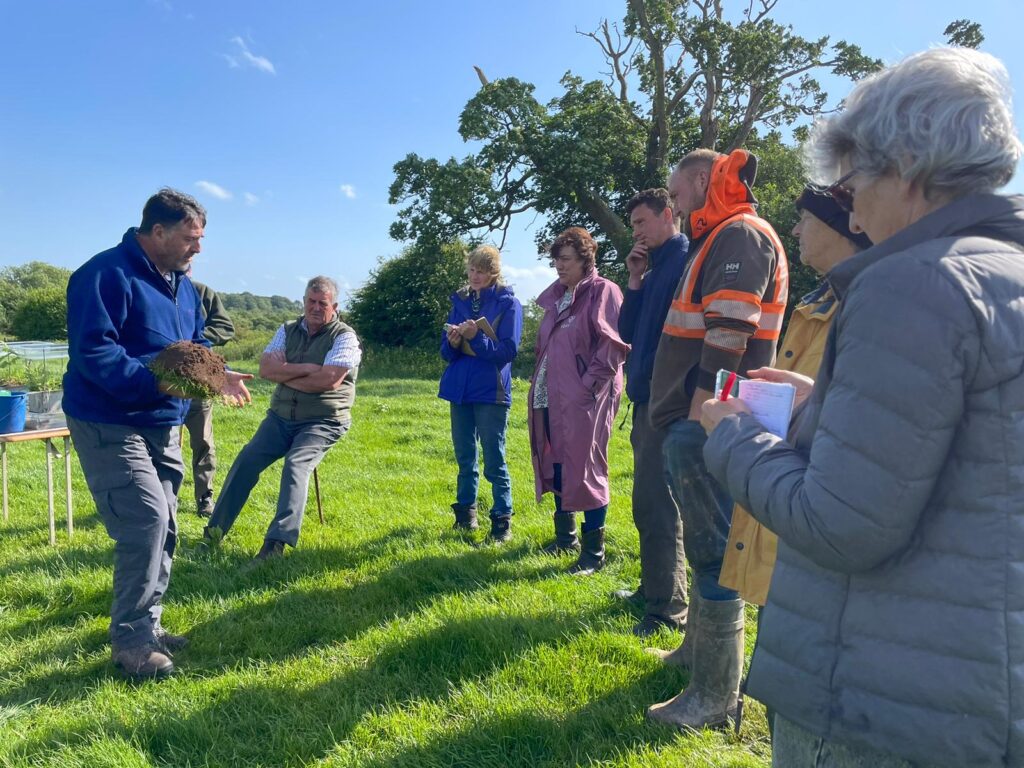
On the 4th June we held a workshop with speaker Charlie Morgan (GrassMaster Ltd) to discuss multi species swards, how can they work in the uplands and a focus on stewardship.
Charlie described farm land as a jigsaw puzzle, various pieces of land are relevant for different purposes. Either traditional livestock production or taking advantage of environmental schemes.
One of the demonstration on the day was of two sods. One taken from a standard dairy field that had been grazed three times this year and was mainly rye grass. The other taken from a field that had been seeded last year as a multi species sward and included Chicory, dandelions and plantains – it looked rough and overgrown compared to the lawn like rye grass sample. Water was then poured on and allowed to percolate through the sods. The ryegrass sample was heavily compacted and the grass had poor roots, meaning the water mainly ran off. The mixed sward with deep rooted plants allowed the water to run through, demonstrating the good drainage provided as a result of the deep root structures.

A Multi Species sward requires 15 different species/square metre, which includes 5 flowering plants and no more than 10% clover. A Herbal Ley is used more for stock production with a mix of grasses and legumes. This is where the jigsaw comes in, some areas of land might be more suitable for a multi species sward that would allow profitability for the farm in different ways. You must be careful that an SSSI is not affected and there are other rules that apply for each different SFI or CS.
Some of the available payments under SFI
Most unimproved grassland will come under CLIG3
CLIG3: Manage grassland with very low nutrient inputs £151 per hectare (ha) per year
However, the payment could increase if the grassland contained a more diverse sward
CSAM3: Herbal leys £382 per hectare (ha) per year
These actions can then be developed into Countryside stewardship schemes.
GS4: Legume and herb-rich swards £382 per hectare (ha) (similar to SFI CSAM3)
GS6: Management of species-rich grassland £646 per hectare (ha) The land must also be mapped on the Priority Habitat Inventory (see the MAGIC website) https://magic.defra.gov.uk/MagicMap.aspx
GS7: Restoration towards species-rich grassland £646 per hectare (ha) (for ten
years)
For a full report on our workshops and more, see the downloads section of our website.